

microwave circuit board withstand harsh environments
Microwave circuit boards are indispensable components for handling high-frequency signals with minimal loss and distortion. They play a critical role in advanced electronic systems, especially in communications and aerospace industries. However, the utilization of microwave PCBs comes with a unique set of challenges and opportunities. The specific intricacies involved in achieving controlled impedance and minimum signal loss require specialized engineering and manufacturing techniques. Continued advancements in materials and manufacturing processes are shaping the future of microwave circuit boards, while pushing the boundaries of what is possible for high-frequency circuitry.
RF and microwave circuit board must be fabricated with precise impedance matching and controlled dielectric constants to prevent signal degradation at extremely high frequencies. The selection of a PCB substrate is also an important factor in microwave PCB design, contingent on operating frequency and application requirements. Typically, thin substrates of between 10 and 20 mils are utilized to minimize signal losses.
Conductor skin effect is another key consideration, as it increases power dissipation and elevated temperatures that can degrade the performance of a circuit board. To mitigate this issue, conductors are often designed with a symmetrical cross-section. This helps to eliminate unwanted voltage variations caused by current flow near the conductor’s surface, thereby improving conductor stability and reliability.
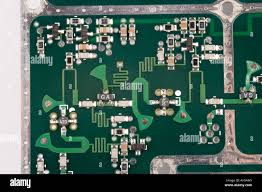
Can microwave circuit board withstand harsh environments?
Lastly, a high-quality RF and microwave PCB must be manufactured with copper and conductor plating that withstands the harsh environment of microwave applications. Achieving this goal requires a high-purity copper (HPCC) substrate with a smooth, low-profile plated finish. Various plating options are available for RF and microwave PCBs, including immersion silver, immersion gold, electrolytic nickel/gold, and ENIG. All of these finishes provide superior conductivity while protecting the copper from corrosion, enabling solderability, and allowing for wire bonding.
Rigorous quality control and testing procedures are essential for ensuring the reliability and compliance of a microwave circuit board. These tests verify that each fabricated PCB meets the stringent specifications of the underlying design. Impedance validation is particularly crucial, as it ensures that transmission lines exhibit accurate characteristic impedance values, minimizing unwanted signal reflections.
Once fabricated, microwave circuit boards undergo rigorous testing and validation to ensure compliance with performance specifications. This may involve a combination of electrical testing, RF measurements, and functional testing under simulated operating conditions. Any deviations from expected behavior are meticulously analyzed and addressed, often requiring iterative design modifications and optimization.
To ensure the accuracy of these measurements, it’s important to choose a reputable and experienced microwave PCB manufacturer. An expert supplier has the resources, team, and experience to deliver a high-quality microwave PCB that exceeds your expectations. They will have a wide range of in-stock laminates, strict impedance tolerance, ultra-thin etch tolerance, and the Plasma process for the best results. A top RF and microwave PCB manufacturer will work with you throughout every step of the production process to make sure your project stays on track. They will even work with you to find the perfect solution for your unique design and assembly.


